
Does He Like Me?
KDR GamesTrivia
4.6743.00 Reviews
- Version
- 10.3.1
- Installs
- 500.00K
- Age Rating
- Everyone
Screenshots
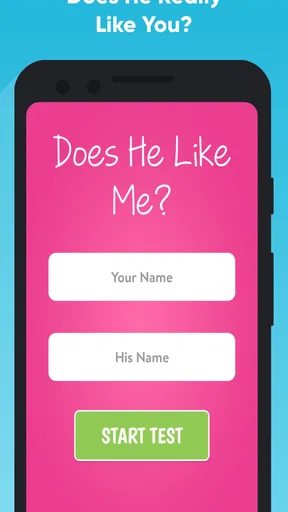
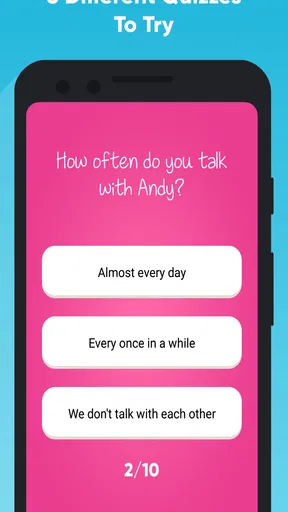
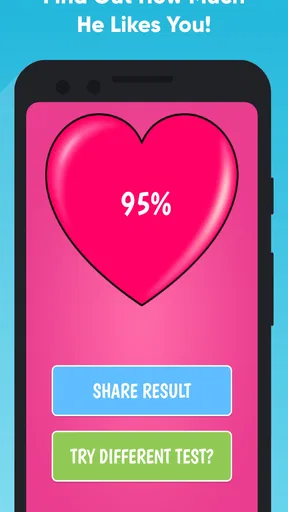
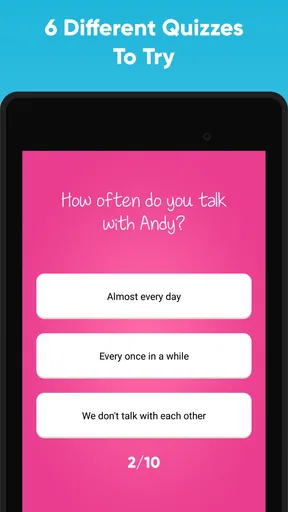
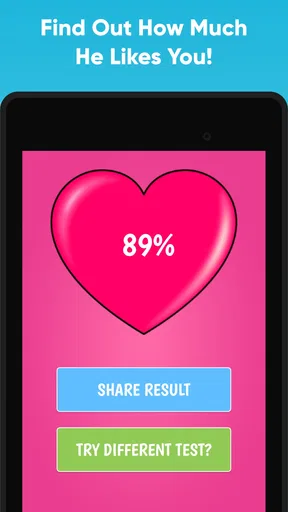
Our Review of Does He Like Me?
 Analysis by Appyee
I approached Does He Like Me? as a light, casual trivia game rather than a serious relationship tool. Its central idea is simple: answer questions about your crush and use the quiz experience to explore whether his behavior might suggest interest. That makes it easy to understand within seconds, and it suits a quick break far better than a long, complicated game.
My main takeaway is that this is best treated as playful entertainment, not as a reliable way to read another person’s feelings. The quiz can give you a reason to think about conversations, signals, and your own expectations, but no result can replace an honest conversation. If you keep that boundary in mind, the game can be amusing. If you want evidence, a detailed dating guide, or a genuinely competitive trivia challenge, you will probably need something different.
A playful quiz with a very specific purpose
Does He Like Me? is a free trivia game from KDR Games, aimed at an Everyone audience. It was released on Jun 28, 2018, and the current version is 10.3.1. The store summary presents it as a fun love test for girls, while the shorter description reduces the idea to a direct question: “Does He Like Me?” That narrow focus is important because this is not a broad collection of general-knowledge questions. The entire experience is built around crush-related curiosity.
I can see why the concept appeals to people. When you like someone, small details can feel unusually important: whether he starts conversations, remembers something you said, or seems different around you. A quiz gives those thoughts a structure. Instead of replaying every interaction in your head without direction, you move through a sequence of prompts and arrive at a result that feels like a conclusion.
That conclusion should be read as a playful interpretation, though. The game cannot observe your conversations, understand tone, or judge context. Even if you answer carefully, the outcome depends on how you describe the situation and how the quiz has been designed to interpret those answers. I found the experience more enjoyable when I treated it as a conversation starter with myself, not as a hidden detector of romantic interest.
The game’s popularity suggests that this simple format has found an audience. It holds an average rating of 4.6 from around 5.4 thousand ratings, with over 500 thousand installs. Those figures make it clear that the premise is easy for many people to understand and try. They do not, however, turn the results into relationship advice. Popularity tells me the idea is approachable, not that the conclusions are scientifically dependable.
What the quiz is really useful for
The most useful part is the reflection it encourages. If I answer honestly, I have to separate what I actually observed from what I merely hope is true. That distinction can be surprisingly valuable. For example, I might initially think a crush is interested because he viewed a message quickly, then realize that I have stronger evidence in the fact that he regularly makes time to talk.
A practical way to use the game is to play once, note which questions make you hesitate, and then stop there. Those uncertain answers often reveal the areas where you need clarity. Rather than repeatedly retaking the quiz until you receive a preferred outcome, I would use the result as a prompt to look at real behavior over time.
It can also work as a social activity with a trusted friend. Two friends can discuss why they chose particular answers and compare interpretations without treating the result as a verdict. That makes the game less private and more conversational, although I would still avoid sharing someone else’s personal details without permission.
A realistic everyday scenario
Imagine that you are waiting for a bus after school or taking a short break between tasks. You have been wondering whether a classmate is friendly to everyone or especially attentive to you. A quick session gives you something to do, and the questions help you list the actual signs you have noticed. You may finish feeling encouraged, uncertain, or amused, but the useful step comes afterward: deciding whether you want to talk to him more directly.
In that situation, the game works because it is low pressure. You do not need to prepare, create an account, or learn a complicated ruleset before engaging with the central idea. At the same time, the low-pressure format is also its limitation. It can organize your thoughts, but it cannot provide the missing information that only a real interaction can reveal.
Fairness, spending, and the pressure to keep playing
Because the game is free, the basic decision to try it is straightforward. I would not approach it expecting a large paid game with deep progression, sophisticated scoring, or a long-term challenge. Its value is in the quick quiz experience. From a spending perspective, the sensible approach is to judge it by the enjoyment of a short, casual session rather than by how much content it might offer over weeks.
The available app details identify the price as free, but they do not establish a purchase system, paid advantages, or specific optional items. I therefore would not claim that it is pay-to-win, nor would I promise that every part of the experience is free of commercial prompts. If spending matters to you, check the current app page and your device’s purchase controls before allowing any transaction. That is especially sensible when a younger player is using the phone.
Fairness also has a different meaning here than it does in a competitive trivia game. There is no meaningful contest against another player in the premise. You are not trying to defeat an opponent with faster answers or build a stronger collection than someone else. The important fairness question is whether the quiz presents its interpretation honestly enough that a player understands it as entertainment rather than proof.
I would be cautious about any result that feels too definitive. A person’s feelings are not determined by a handful of generalized answers, and a disappointing result should not be treated as a judgment on your attractiveness or worth. Likewise, an exciting result should not be used to justify invading someone’s privacy, testing them, or pressuring them for a confession. The healthiest way to play is to keep the result emotionally light.
Where progress can become pressure
This type of game does not need elaborate progression to create pressure. The pressure can come from the question itself. If you are anxious about a crush, you may feel tempted to replay the quiz, change one answer, and search for a more reassuring outcome. That behavior can turn a harmless activity into a loop of seeking confirmation.
My advice is to set a personal limit before starting. Play it once for fun, perhaps discuss the result with a friend, and then return to real-world evidence. If you notice that the quiz is making you more worried rather than more relaxed, it has stopped serving its purpose. Closing it is a better choice than trying to force certainty from another attempt.
This is also why I would not recommend it as a daily routine. A general trivia game can reward learning new facts, while this quiz mainly revisits one emotional question. Repetition is unlikely to produce better knowledge about the person you like. It may only make you focus more intensely on the game’s interpretation.
Competitive fairness compared with ordinary trivia
Compared with a standard trivia app, Does He Like Me? is not testing knowledge in the usual sense. There are no facts to memorize and no objective answer key for whether a particular person has romantic feelings. Your answers describe a situation, so the experience is subjective from the start.
That makes it fair in one sense: everyone engages with the same kind of personal question, and there is no need to be an expert. It is less fair if you expect consistent, evidence-based scoring, because two people could interpret the same behavior differently and arrive at different answers. A conventional quiz is the better choice when you want clear right-or-wrong answers, measurable improvement, or a genuine leaderboard-style challenge.
A personality quiz may be a closer alternative, especially if you enjoy reflective questions and broad interpretations. A dating advice app may be preferable if you want practical guidance about communication, boundaries, or consent. A messaging conversation with the person involved is the strongest alternative when your real goal is certainty. The game is most suitable in the space between idle entertainment and personal reflection.
Details I would check before installing
The game supports devices running Android 7.0 or later, which gives it a reasonably clear compatibility point for Android users. Before downloading, I would still check the current device requirements shown on your own store because operating-system support and store availability can change over time.
I would also decide whether the subject matter is comfortable for the intended player. The content rating is Everyone, so the game is positioned for a broad audience, but a crush quiz can still feel personal or embarrassing depending on who is using it. A parent or guardian may want to explain that the result is only a game, particularly if a child tends to take quiz outcomes literally.
Privacy is another practical consideration. I would avoid entering identifying details about the crush, such as a full name, school, address, or private messages, unless the app explicitly requires and responsibly explains that information. A quiz about feelings should not become an excuse to expose somebody else’s personal life. Keeping answers general protects both the player and the person being discussed.
Unknowns that affect the decision
Some parts of the experience can change with an update, device, or current store configuration, so I would inspect the live app page before making a final decision. In particular, I would look at the latest screenshots, permissions, advertising presentation, and any purchase wording. Those details matter when deciding whether a free casual game fits your comfort level.
I also would not assume that the version number alone tells me how substantial the game is. Version 10.3.1 indicates an established release line, but it does not reveal how many quiz formats exist, how often content changes, or whether the central result system has been redesigned. I would judge those points from the current in-app experience rather than from the number attached to the release.
The same caution applies to the rating. An average of 4.6 is encouraging, and the game has 743 written reviews, but ratings are personal reactions. Some players may enjoy the theme, while others may expect more depth or more dependable conclusions. I read that reception as evidence that the concept works for many users, not as a guarantee that it will match every player’s expectations.
There is also an important difference between a fun result and a useful result. If the quiz gives you a positive answer, that may brighten your mood, but it does not establish consent, commitment, or compatibility. If it gives you a negative answer, it may reflect cautious responses rather than the other person’s actual feelings. I would never use either outcome to pressure someone or to make a major emotional decision without real communication.
Who should try it, and who should skip it
I would recommend trying it if you enjoy short, theme-focused quizzes, want a playful activity to share with a friend, or need a gentle prompt to examine what you have actually noticed about a crush. It is also a reasonable choice for someone who understands that quiz results are entertainment and can leave the app without feeling compelled to repeat the test.
I would skip it if you are looking for factual relationship analysis, professional emotional support, or a deep game with strategic progression. It is not the right tool for resolving serious uncertainty, handling rejection, or deciding whether a relationship is healthy. In those cases, a trusted person, a qualified counselor, or a direct and respectful conversation will be more useful.
I would also avoid recommending it to someone who is already obsessing over a crush’s every action. The game’s focused premise may intensify that attention instead of easing it. A broader activity, a break from social media, or a conversation grounded in boundaries would be a healthier alternative.
My trust verdict
After considering its purpose, I see this as a small entertainment app with a clear emotional hook. KDR Games has made the concept immediately accessible: you answer questions, think about the situation, and receive an interpretation. The free price and Everyone rating lower the barrier to trying it, while the strong average reception and substantial install base show that many people find the format appealing.
My trust in it has limits, and those limits are central to using it well. I trust it as a playful prompt, not as a source of truth about another person. I trust it to help some players articulate what they have observed, but not to replace communication. I would keep personal information minimal, review the current purchase and privacy details before use, and avoid repeated attempts aimed at changing the result.
The best way to play is to enjoy the quiz without handing it authority over your feelings. If you want a quick, harmless diversion around crush-related curiosity, it is worth considering. If you want reliable answers, competitive trivia, or meaningful relationship guidance, choose an alternative designed for that purpose. Used with that distinction in mind, Does He Like Me? can be a fun conversation starter rather than a misleading promise of certainty.
Verdict
Strengths of Does He Like Me?
- Simple questions make the quiz quick and easy to complete.
- Works well as a lighthearted conversation starter with friends.
- Results are presented in a clear, easy-to-understand format.
- Suitable for casual users without requiring dating experience.
- Can offer a fun distraction when you want a quick relationship-themed quiz.
Limitations of Does He Like Me?
- Results are based on entertainment, not genuine psychological analysis.
- Questions may feel repetitive after multiple attempts.
- The outcome can oversimplify complicated romantic situations.
- Some features may depend on ads or in-app purchases.
- Privacy details should be checked before sharing personal relationship information.
Other Releases by KDR Games
View All
Would You Rather Choose?
Trivia4.1

5th Grader Quiz: Are You Smart
Trivia4.5

Couples Games for Date Night
Trivia4.2
Similar Picks in This Category
View All
Millionaire 2026 Quiz & Trivia
Quiz & Trivia Games by Submarine Apps4.5

Brain Test 2: Tricky Stories
Unico Studio4.7

Trivia Crack: Brain Quiz Games
etermax4.4

QuizzLand. Quiz & Trivia game
Quiz & Trivia Games by Mno Go Apps4.8

Brain Test: Tricky Puzzles
Unico Studio4.7

Logo Quiz
bubble quiz games4.5
Frequently Asked Questions
What is “Does He Like Me?” and how does it work?
“Does He Like Me?” is a relationship and compatibility-style app designed to help users reflect on someone’s possible feelings and the dynamics between them. It may use answers to questions, personal details, or playful calculations to produce an interpretation. The results should be treated as entertainment and a conversation starter, not as a scientifically proven way to read another person’s emotions.
Can “Does He Like Me?” really tell whether someone has romantic feelings?
No app can reliably know what another person feels without honest communication. “Does He Like Me?” can offer a fun prediction or compatibility result based on the information you provide, but its conclusions are not guaranteed to be accurate. Use the app as a lighthearted tool for self-reflection, and avoid making important relationship decisions based only on its results.
Is “Does He Like Me?” suitable for teenagers and younger users?
Suitability depends on the app’s current age rating, content, and privacy policy on the relevant app store. Younger users should review the rating and ask a parent or guardian before installing it, especially if the app requests personal information. It is also important to remember that relationship advice or romantic predictions may not be appropriate for every age group.
Does the app require personal information or access to my phone?
Before downloading, check the permissions and data-safety details listed on Google Play or the App Store. Some versions of relationship apps may request names, birth dates, photos, or other details to create personalized results, while others may work with minimal information. Avoid entering sensitive data, and only grant permissions that are clearly necessary for the app’s main features.
Is “Does He Like Me?” free to download and use?
The app may be available as a free download, but some features can include advertisements, optional purchases, subscriptions, or locked results. Pricing and available features may differ between Android and iOS and can change after updates. Review the store listing carefully before installing, and check subscription terms so you understand whether payments renew automatically.
Play our best games!


